Modern 3D printing has long gone beyond a hobby or prototyping — today it is a tool for creating functional, durable, and heat-resistant parts for engineering, manufacturing, and industrial design.
This year, Polymaker introduced truly revolutionary innovations for PLA 3D printing — HT-PLA and HT-PLA-GF. They open a new era in the world of FDM/FFF printing: these new materials are not just high-performance on paper — their properties are confirmed by real tests and practical use cases. High-temperature PLA can now replace some more complex and expensive filaments, while remaining easy to print, stable, and affordable.

HT-PLA: Heat resistance without compromise
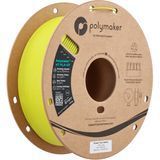
HT-PLA from Polymaker — is a new-generation PLA with enhanced heat resistance, featuring a heat deflection temperature of 152°C, which is significantly higher than classic PETG, ABS, or even ASA. This filament is ideal for electronic housings, automotive parts, engineering prototypes, and even decorative elements exposed to sunlight or operating temperatures above 100°C.

HT-PLA is easy to print, demonstrating stable adhesion and minimal shrinkage. A maximum printing speed of up to 300 mm/s allows efficient production of large parts without loss of quality, making it a universal choice for both beginners and experienced users.

HT-PLA-GF: Heat resistance with enhanced strength
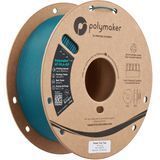
HT-PLA-GF from Polymaker — is a high-temperature PLA variant reinforced with glass fiber, providing increased rigidity and resistance to mechanical loads. Its heat deflection temperature is about 145.2°C, and it is worth noting that glass fiber reinforced material requires a hardened nozzle for printing to avoid rapid wear and ensure process stability. This filament can be used as a more affordable alternative to advanced composites in functional prototypes and production parts.

HT-PLA-GF is ideal for parts subjected to high mechanical loads, such as functional prototypes, tools, mounts, or automotive components. The filament demonstrates excellent accuracy and stability, and with a printing speed of up to 350 mm/s, it becomes a practical choice for professional applications.
|
Characteristic |
HT-PLA |
HT-PLA-GF |
|
Printing speed |
up to 300 mm/s |
up to 350 mm/s |
|
Vicat Softening Temp. |
152°C |
145.2°C |
|
Young's Modulus (X-Y) |
3267.16±66.41 MPa |
3267.16±66.41 MPa |
|
Tensile Strength (X-Y) |
42.86±0.76 MPa |
42.86±0.76 MPa |
|
Bending Modulus (X-Y) |
2960.42±46.91 MPa |
2960.42±46.91 MPa |
|
Young's Modulus (Z) |
2596.43±160.44 MPa |
2596.43±160.44 MPa |
|
Tensile Strength (Z) |
18.82±0.98 MPa |
18.82±0.98 MPa |
|
Bending Modulus (Z) |
2411.22±139.22 MPa |
2411.22±139.22 MPa |
|
Impact Strength (X-Y) |
4.67±0.20 kJ/m2 |
4.92±0.5 MPa |
|
Impact Strength (Z) |
4.39±0.18 kJ/m2 |
4.37±0.27 MPa |
Both materials — HT-PLA and HT-PLA-GF — from Polymaker offer high heat resistance and easy printability. HT-PLA is ideal for general applications where heat resistance is important without additional mechanical load. HT-PLA-GF, thanks to the addition of glass fiber, provides increased mechanical strength, making it ideal for manufacturing parts exposed to high mechanical and thermal loads. The choice between these filaments depends on the specific requirements of the final product.

These innovations from Polymaker prove that high-temperature PLA can be a practical, reliable, and affordable material for complex engineering applications. High levels of mechanical strength and thermal stability, along with ease of printing, make HT-PLA and HT-PLA-GF some of the most exciting filaments of this year.
Buy HT-PLA and HT-PLA-GF on our LFL3D website, where original Polymaker filaments are available for Ukrainian 3D makers at official European prices. Order today — print tomorrow!