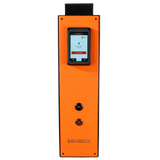
An in-line dryer for FDM/FFF that conditions not the entire spool in advance, but only the section of filament moving toward the extruder. We explain how the system works, which materials benefit from it, and what changed in version v1.5.
1.75 mm
supported diameter
4.3″
touchscreen display
<50 dBA
noise level
350 W
maximum power
Moisture in filament is not only a matter of part appearance. With hygroscopic polymers, it can affect extrusion stability, surface quality, interlayer adhesion, and dimensional repeatability.
Drywise approaches the problem differently from a conventional dryer: the spool stays outside while the system treats the filament directly on its way to the 3D printer. In other words, the material is dried exactly when it is needed for printing.
What is Drywise?
Drywise v1.5 is a filament pre-conditioning system for FDM/FFF printing. Inside the unit, filament passes through a controlled thermal and airflow path with a closed loop and desiccant. Tested profiles are used for different materials, while sensors monitor system operation.
In-line drying
The system dries only the section of filament moving toward the extruder, not the entire spool.
Closed loop
Dry air circulates through the desiccant system, maintaining stable processing conditions.
Material profiles
The system uses tested parameters for specific polymers and blends.
Autoloader
Motorized feeding reduces tension in the filament path and load on the extruder.
How does Drywise work?
01
Load the filament
The spool remains outside. Filament passes through the Drywise inlet and the internal filament path.
02
Select a profile
Select the appropriate material on the screen. Drywise uses predefined modes instead of requiring manual parameter selection.
03
Conditioning
The filament passes through a controlled warm, dry environment where excess moisture is removed.
04
Printing
During printing, the system continues conditioning the next section of filament, maintaining a continuous process.
!
Drywise is not a dry box for spool storage
Its purpose is to bring the material to the required condition immediately before extrusion. The spool is not placed inside a drying chamber, so spool size is not limited by the internal volume of the unit.
What happens to wet filament?
Hygroscopic polymers absorb water from the air, which then enters the hotend together with the material. When heated, the water turns into steam and can disrupt melt-flow stability. The effects depend on the specific polymer and moisture level.
Stringing and oozing
Material flow and retractions become harder to control.
Surface defects
Bubbles, pits, roughness, and uneven extrusion may occur.
Weaker interlayer adhesion
Voids and unstable extrusion can negatively affect part strength.
Lower repeatability
Material condition becomes another variable affecting the geometry and quality of repeat production parts.
Autoloader in Drywise v1.5
One of the major changes in v1.5 is the motorized Autoloader. It actively moves filament through Drywise so the printer extruder does not have to pull the spool, guides, and the dryer’s entire internal filament path at the same time.
Minimal tension
The Autoloader maintains filament feed with near-zero tension in the filament path.
Large spools
Motorized feeding is especially useful with heavy spools of 3 kg or more.
Flexible materials
Lower pulling resistance helps prevent unnecessary stretching of soft filaments.
Which materials work with Drywise?
In-line drying is most beneficial when working with hygroscopic engineering materials. The manufacturer continuously expands the list of tested profiles, so before starting a print, check that a profile is available for your specific filament.
PA / NylonPA-CFPETGTPUPCPEI / UltemPEEKPEKKABSSupportPLA
Important: Drywise uses material-specific profiles. If your exact filament is not listed, do not substitute an arbitrary profile intended for a different material.
3D printer compatibility
Drywise is installed in the filament path before the extruder and can be integrated with a range of FDM/FFF platforms. Compatible systems include printers from the following manufacturers:
Vision Miner
Professional FDM/FFF systems for engineering materials.
Ultimaker
Drywise is installed in the filament path before material enters the extruder.
Raise3D
External in-line filament drying before the material is fed to the printer.
Markforged
Drywise works as a standalone material-conditioning module before extrusion.
Prusa
The system integrates into the external filament path before the extruder.
Bambu Lab
Drywise can be used as an external filament-conditioning system before printing.
Drywise v1.5 technical specifications
Model
Drywise v1.5 In-Line Filament Dryer with Autoloader
Technology
In-line filament pre-conditioning for FDM/FFF
Filament diameter
1.75 mm
Feeding
Inlet/outlet guides + motorized Autoloader
Interface
4.3″ capacitive touchscreen + LED indicators
Connectivity
USB-C
Noise level
< 50 dBA
Dimensions
520 × 500 × 145 mm; with desiccant container — 590 × 500 × 145 mm
Weight
12 kg; with desiccant container — 12.5 kg
Power supply
100–240 V AC, 50–60 Hz
Maximum power
350 W
Warranty
12 months
System maintenance
Drywise uses replaceable desiccant cartridges and seals in the filament path. Closed-loop airtightness is important for stable drying, so the condition of the desiccant and O-rings is part of routine maintenance.
Desiccant
Cartridges can be replaced and regenerated according to the manufacturer’s instructions.
O-rings
O-rings maintain the airtightness of the filament path and should be kept in good condition.
Firmware
The manufacturer releases firmware and profile updates, so the system should be kept up to date.
LFL3D · real-world test
How Drywise works in practice
We tested Drywise with a real 3D printer, showing the connection, setup, system operation, and the difference between printing with dry and wet filament.